VCN AND ULTRASONICS CLEANING
VCN AND ULTRASONICS CLEANING OF POROUS PARTS:
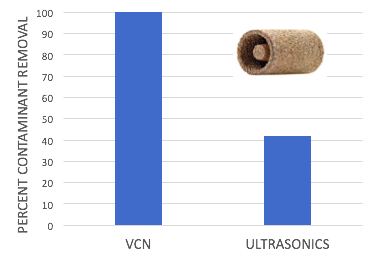
A porous filter having an average pore diameter of 10 microns was positioned within a vacuum chamber, which was evacuated to a pressure of less than 1 mmHg. A water-soluble oil was then introduced into the chamber to fully immerse the filter. After restoring the chamber to atmospheric pressure, the filter was weighed with an accuracy of 1 milligram.
Two filters were subjected to cleaning in a surfactant solution for a duration of 2 minutes: one filter undergoing the Vacuum Cycling Nucleation (VCN) process, and the other immersed in a 40 kHz ultrasonic bath operated at a power density of 100 watts per gallon. The resulting effects are depicted in the accompanying graph.
VCN and Ultrasonic Cleaning Efficiency of a Porous Filter
VCN AND ULTRASONICS CLEANING OF A TUBE:
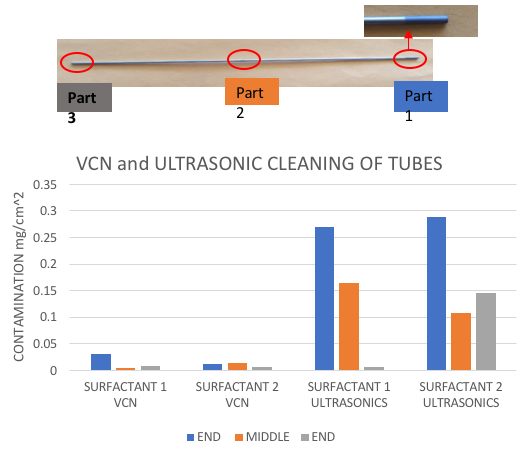
11-inch-long, 0.2-inch-diameter tubes were filled with mineral oil and subsequently drained to achieve an internal coating with an average mass density of 0.25 mg/cm².
Two tubes were subjected to cleaning in a surfactant solution for a duration of 2 minutes: one using the VCN process and the other employing a 40 kHz ultrasonic bath operating at 100 watts per gallon. Post-cleaning residual oil was quantified via a total carbon analyzer. The data collected from three distinct locations within each tube, as illustrated in the figure, are presented in the accompanying graph.