Leaching From Porous Metal Filter
Vacuum Cycling Nucleation (VCN) for internal cleaning of parts:
- VCN operates within tightly controlled offsets. During the initial vacuum phase, air is evacuated from the internal cavities of the component. In the subsequent pressure cycle, fluid is injected to fill the internal voids.
- During repeated vacuum cycles, vapor bubbles nucleate and expand within the component, displacing the internal fluid.
- This process facilitates the removal of reactant chemicals, soluble materials, particulate contaminants, and surfactant micelles.
- Following this, pressure cycles allow the influx of treatment fluids containing fresh chemicals.
- The process repeats iteratively until complete processing of the part is achieved.
- The accompanying figure illustrates this cyclical procedure.
Vacuum Cycle Nucleation in Small Spaces
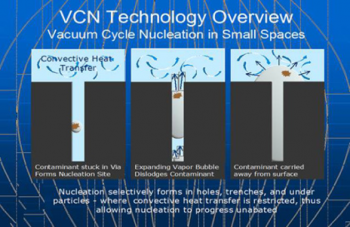
Nucleation occurs preferentially within voids, trenches, and beneath particulate matter, where convective heat transfer is significantly impeded, thereby enabling unimpeded nucleation progression.
The video depicts a 10-inch-diameter roll of wound screen, producing a precise matrix of microchannels for fluid transfer. The screen is produced by a stamping process and is immediately wound after stamping, resulting in oil residue. The operational fluid used is n-Propyl Bromide.