Vacuum Cycle Nucleation (VCN)
How to Clean Porous Metal Parts
Vacuum Cycle Nucleation (VCN) is the most exciting advancement in industrial cleaning since the introduction of ultrasonics. VCN provides superior performance in both aqueous and solvent applications.
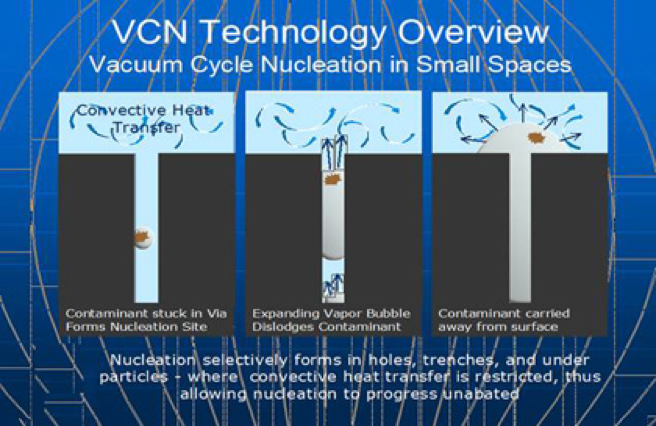
Nucleation preferentially occurs within cavities such as holes, trenches, and beneath particulate matter, where convective heat transfer is minimized. This environment facilitates more efficient vapor bubble initiation and growth, thereby enabling continuous nucleation and enhancing cleaning efficacy.
Solvent Cleaning of Wound Screen in Field Unit
The video shows a wound screen 10” diameter roll producing a matrix of very small passages for fluid transfer. Recognizing the critical role of cleaning, the screen comes from a stamping machine that is dripping with oil since it is wound immediately after stamping. The fluid is n-Propyl Bromide, and the screen is made of copper.
The VCN process nucleates vapor bubbles on the screen, which helps dislodge spent fluid from the matrix. When the vacuum is paused, fresh fluid quickly enters the screen to continue cleaning, ensuring effective removal of contaminants.
Vacuum Cycling Nucleation (VCN) for internal cleaning of parts:
- VCN operates within confined offsets, ensuring precise internal cavity evacuation during the initial vacuum cycle by removing air from the interior of the component.
- During the initial pressure cycle, fluid is injected into the microscopic voids within the component.
- During subsequent vacuum cycles, vapor bubbles increase in size within the component, exerting pressure that displaces fluid from its internal passages.
- Reactant chemicals, soluble substances, particulate matter, and surfactant micelles are removed from the component during this cycle.
- During subsequent pressure cycles, fluid reenters the internal chambers of the component, delivering fresh treatment chemicals.
- Cycling persists until the component undergoes complete processing.