Multiple Chamber Cleaning Systems
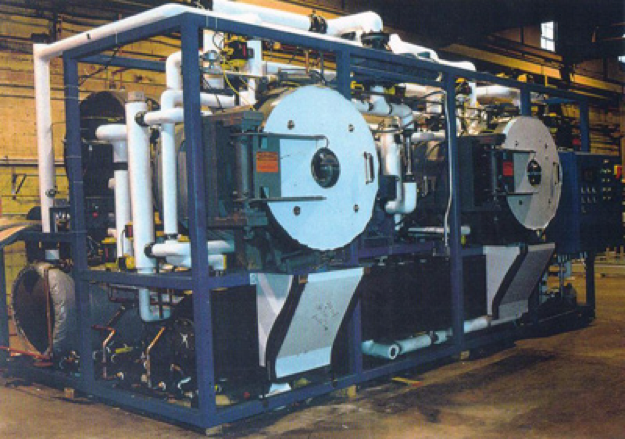
Multi-chamber systems enhance throughput capacity and enable an uninterrupted material flow during the cleaning process. A typical 20-minute cleaning cycle employs a dual-system configuration, facilitating the removal of components at 10-minute intervals.
Dual systems comprise two processing chambers powered by a single vacuum pump. They utilize one solvent cleaner supply tank, one distillation vessel, and one clean holding tank, offering the functionality of two independent systems at a marginal increase in cost.
Implementing a dual system configuration enhances throughput by approximately 90%. Incorporating a third chamber elevates the combined dual-unit throughput by roughly 80%. Integrating automation functions effectively simulates the operation of an inline degreaser.
Multiple treatment options are implemented through the addition of support tanks. Aqueous processing systems typically incorporate a deionized (DI) rinse holding tank and a cleaning solution tank. An additional tank can be integrated for passivation procedures or the application of corrosion inhibitors. In medical device sterilization systems, hydrogen peroxide or peracetic acid are employed as sterilizing agents.
Since our systems achieve complete drying, there is no risk of cross-contamination between different chemical agents. For example, a solvent can be used for cleaning, followed by the application of an aqueous corrosion inhibitor without any mixing of chemistries. Incorporating support tanks provides an additional processing stage at a low cost.